Information for schools

Making a Request for Support to RTLB Cluster 25

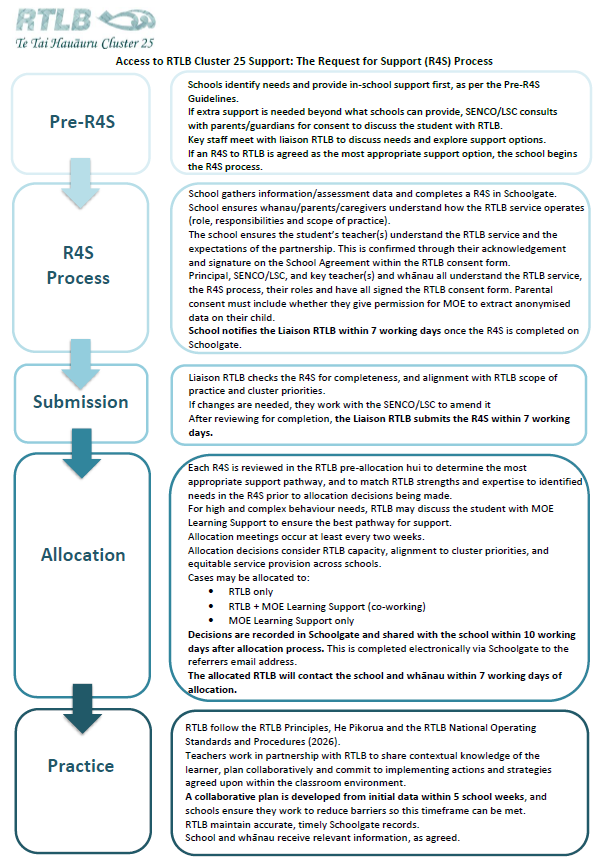
  1. The school identifies a need and talks with their Liaison RTLB to check the request fits within RTLB scope of practice.

  2. Data and assessment is gathered that reflect a need for support.

  3. Parent / whānau consent is gained for the Request for Support.

  4. A Request for Support and completed on Schoolgate by the school.

  5. The school notifies RTLB that the Request for Support is ready to be submitted.

  6. The RTLB submits the Request for Support.

Before any RTLB support can be provided, we need written consent from parents / whānau, and a school agreement signed by key staff. This is collected on our 2026 Consent Form.

You can download our 2026 consent form here.

Not sure if you need RTLB or MOE support?

RTLB Cluster 25 has a flexible pathway agreement with MOE Te Mahau / Learning Support.


This agreement is grounded in a shared understanding between our services, that:

  • There should be multiple and flexible ways for schools to request the support they need.

  • The method of requesting support should never become a barrier for schools - what matters most is the quality of the information shared and the conversations that follow between the RTLB Service and local MOE Te Mahau.

  • Whether a school uses Schoolgate or the MOE Direct Referral Form, there is no wrong way to refer.

If you want to discuss concerns about a stduent with MOE, click here for Whanganui, and click here for Palmerston North.

Allocations of Requests for Support

Allocation meetings in Cluster 25 happen fortnightly and the wait time is dependent on service capacity.

Once allocated, a RTLB will make contact with the school and parents/whānau to meet, within one week of allocation and will work with key staff and parents / whānau to:

  • Ensure teachers and parents / whānau know how RTLB work

  • Build an understanding of the learner and their learning environment

  • Observe, gather information, and listen to those involved

  • Work collaboratively with teachers and parents / whānau

  • Collaboratively develop a support plan within 5 weeks of allocation, based on the needs identified

The RTLB then supports the teacher and school team to implement strategies, adjust teaching practice, and monitor progress.

RTLB involvement is a partnership focused on strengthening teaching practice so that the learner can experience success as part of their everyday classroom programme.

RTLB support requires active participation and engagement from teachers and school staff in meeting, planning, implementing, monitoring and reviewing agreed actions and strategies. Teachers and school staff involved will need to commit to this when working with the RTLB Service.

Working with the RTLB Service

National Service Operating Standards and Procedures (OSP’s)

RTLB practice sits within the national Operating Standards and Procedures set by the Ministry of Education for all learning support services across Aotearoa New Zealand.

These standards describe how services are delivered, ensuring a shared and consistent experience for schools, kura, learners, and whānau, no matter where they are in the country.

The OSPs focus on four key expectations:

  • Consistency — learners, whānau, schools, and kura experience RTLB support in a similar way, regardless of location

  • Timeliness — support is provided as quickly and efficiently as possible within national timeframes

  • User-centred practice — the needs and experiences of the learner remain at the heart of the process

  • Accessibility — services are delivered in ways that actively remove barriers for those accessing support

These standards guide the way RTLB Cluster 25 delivers support to ensure our work is aligned with national expectations while remaining responsive to the needs of our local schools and communities.